
Kimi K3 Use Cases: What Moonshot AI’s New Model Actually Does
Moonshot AI’s newest open-weight frontier model, Kimi K3, was announced July 16, 2026 as the successor to Kimi K2, and its use cases cluster into seven areas: coding, long-document analysis, agentic automation, research, writing, data analysis, and multilingual work. According to Moonshot’s own technical blog, the model is presented as “the world’s first open 3T-class model,” designed for frontier intelligence across long-horizon coding, knowledge work, and reasoning, and built around a sparse Mixture-of-Experts (MoE) design.
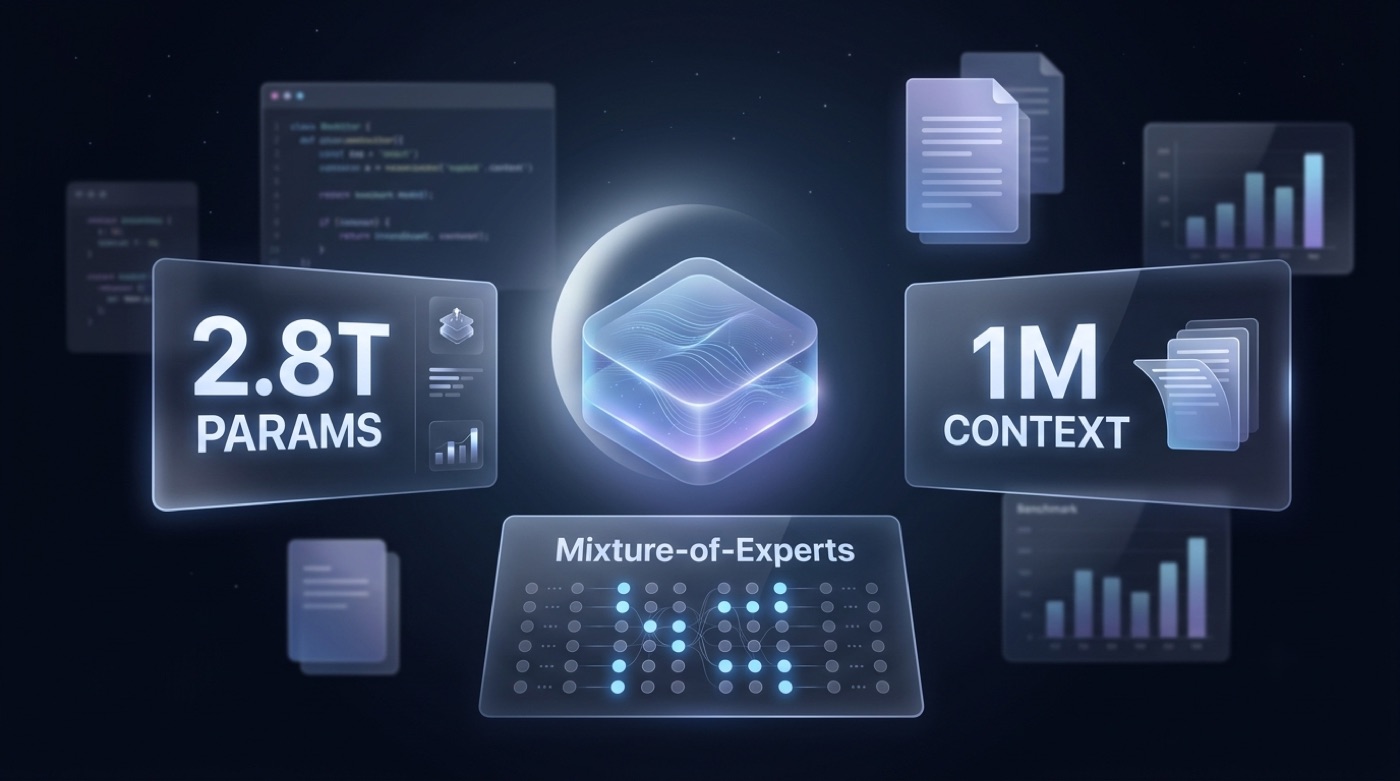
The reason it can cover so much ground in one model is architectural: a sparse MoE with roughly 2.8 trillion total parameters (only 16 of 896 experts active per token) paired with a 1-million-token context window, so a single prompt can hold an entire codebase, a book, or a folder of contracts at once.
Quick disclaimer before we go further: kimik3.pro is an unofficial free chat and reference for Kimi K3. It is not affiliated with, endorsed by, or operated by Moonshot AI.
Kimi K3 at a Glance: Why the Architecture Enables These Use Cases
Every use case below traces back to three architectural choices Moonshot AI made with K3: a sparse MoE that keeps inference cheap despite a huge parameter count, a new attention mechanism built for very long contexts, and native vision. Together they explain why the same model handles a 500-file repository, a 300-page contract, and a chart screenshot without switching tools.
The specs that matter for real work
The concrete numbers, as reported by Moonshot AI at launch: 2.8 trillion total parameters with 16 of 896 experts active per token, a 1-million-token context window, and native vision input. Two components do most of the heavy lifting. Kimi Delta Attention (KDA) is a hybrid linear attention mechanism that Moonshot reports gives up to 6.3x faster decoding at million-token context scale — the difference between a long session feeling sluggish and staying usable. Attention Residuals (AttnRes) reportedly add around 25% training efficiency at under 2% extra cost, which is more relevant to Moonshot’s training bill than to end users, but it signals how the model was built to scale.
| Parameter | Value (per Moonshot AI, at launch) |
|---|---|
| Total parameters | ~2.8 trillion |
| Active experts per token | 16 of 896 (sparse MoE) |
| Context window | 1,000,000 tokens |
| Modality | Text + native vision |
| Attention mechanism | Kimi Delta Attention (KDA), hybrid linear attention |
| Training efficiency add-on | Attention Residuals (AttnRes) |
| Release date | July 16, 2026 |
| Open weights | Expected ~July 27, 2026 |
From K2 to K3: what changed
K3 succeeds Kimi K2, Moonshot’s earlier model already known for strong coding and agentic tool use. K3 scales the architecture up into 3T-class territory and extends both context length and modality, and it is positioned by Moonshot as a step up in agentic capability rather than a simple parameter-count refresh.
What’s new compared to K2, based on Moonshot’s launch materials:
- A larger sparse MoE backbone (2.8T total, 3T-class positioning) versus K2’s smaller expert count
- A 1-million-token context window for holding entire repos, books, or document sets
- Native vision, so the model can read screenshots, mockups, and charts directly
- An expanded coder-subagent toolset — background tasks, todo lists, plan mode, skill invocation, and nested agents
Use Case 1 — Coding & Software Engineering
Coding is the headline capability Moonshot leads with. The OpenRouter model page describes Kimi K3 as excelling at complex coding, knowledge work, and long-horizon agentic workflows.
Strong at navigating large repositories, using tools, debugging, and iterating against images, logs, tests, and runtime feedback.
OpenRouter, Kimi K3 model page
Repo-scale engineering, not snippets
Because the 1M-token context can hold a whole repository at once, K3 can sustain long engineering sessions with minimal supervision instead of working file-by-file. In practice that means a developer can drop an unfamiliar codebase into the context, ask for an architectural map, then request a cross-file refactor or a dependency migration without re-explaining the project structure at every step — the model already has it all in view.
Vision-integrated debugging & frontend
Native vision lets K3 iterate against screenshots, UI mockups, error logs, and test output in the same session. That’s useful for frontend engineering specifically: reproducing a visual bug from a screenshot, converting a design mockup into working markup, or comparing a rendered page against a Figma export without describing the discrepancy in words first.
Concrete engineering scenarios
Moonshot AI’s own demos (labeled here as vendor-reported, not independently verified) walk through several concrete scenarios:
- GPU kernel optimization
- Building MiniTriton, a Triton-like compiler
- Turning concepts, images, and videos into playable games
- Chip design
- Coding for scientific research, bridging literature and executable code
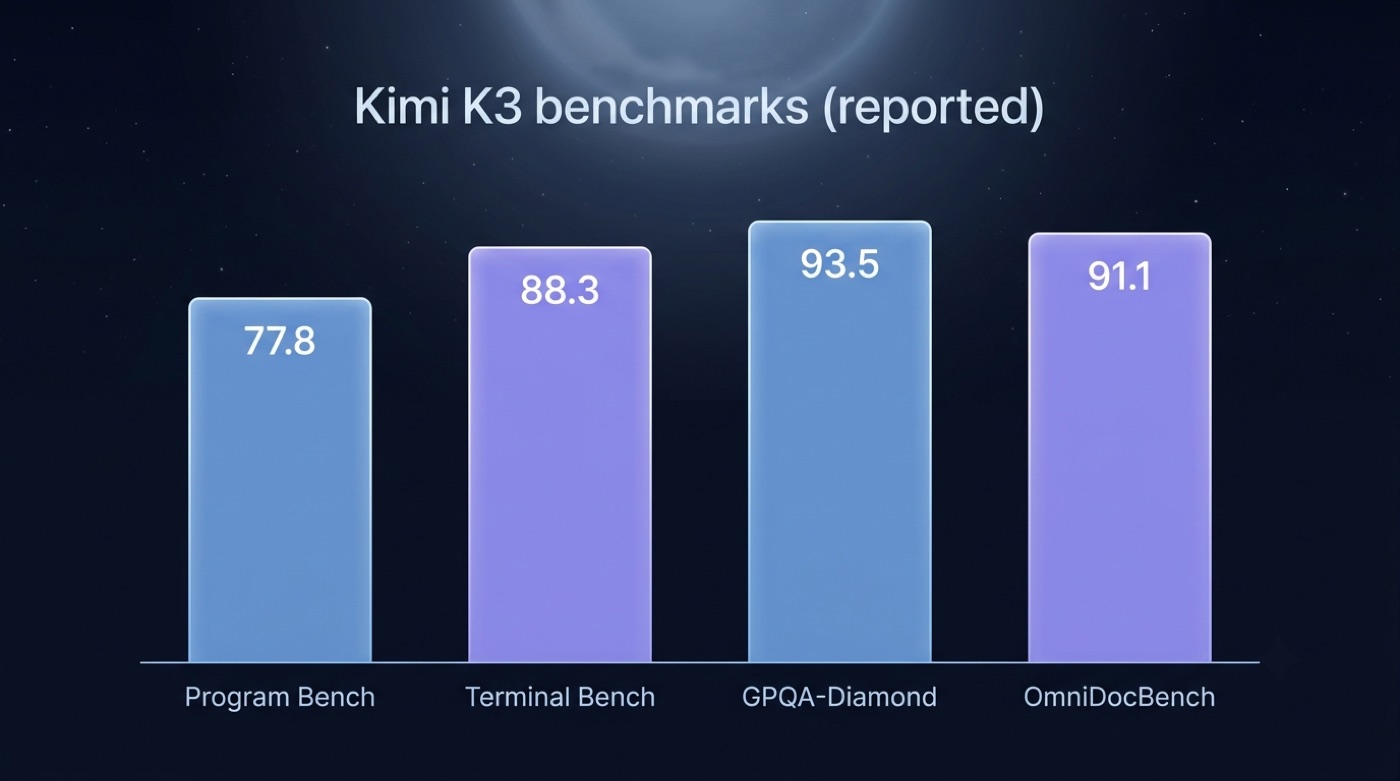
Moonshot also reports coding benchmark scores of 77.8 on Program Bench and 88.3 on Terminal Bench 2.1 — figures Moonshot published at launch and worth treating as vendor-reported until independently reproduced.
Use Case 2 — Long-Document Analysis & Summarization
A 1-million-token context turns “read this one document” into “read this entire folder.” Moonshot reports a 91.1 score on OmniDocBench, a benchmark for document understanding, which lines up with the model’s stated strength in parsing long, structured documents.
What a 1-million-token window unlocks
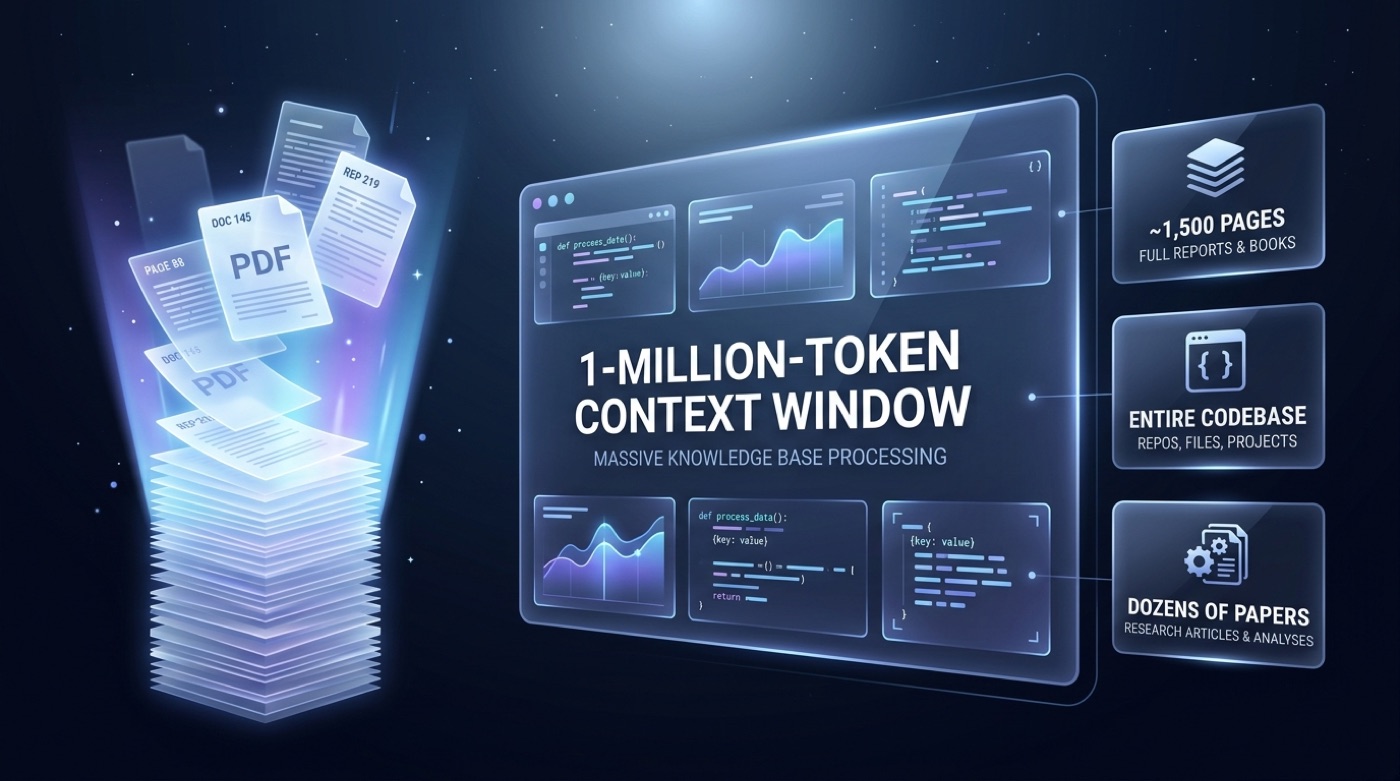
One prompt can hold an entire book, a full contract set, or dozens of research papers — no chunking, no manual splitting, no losing earlier context halfway through. As a rough intuition, 1M tokens corresponds to several thousand pages depending on content density; treat the row below as an approximation, not a guarantee.
| Content type | Roughly fits in 1M tokens |
|---|---|
| Plain text | ~1,500 pages |
| Codebase | An entire mid-size repository |
| Research papers | Dozens of full papers |
| Contracts/filings | A multi-document deal set |
Real long-document scenarios
Typical scenarios where the long context does the heavy lifting:
- Contract and policy review with cross-references between clauses spread across many pages
- Summarizing a bundle of research papers into one synthesis
- Extracting specific facts from financial filings without pre-splitting the document
- Question-and-answer over a long technical manual
- Comparing two long documents side by side for differences
Use Case 3 — Agentic Automation & Tool Use
Beyond single-turn chat, K3 is built for long-horizon agentic workflows — the kind where a task takes many steps, tool calls, and self-checks before it’s done. The Kimi K3 chat interface exposes some of this directly, while the API exposes the full tool-calling surface for developers.
Long-horizon, multi-step automation
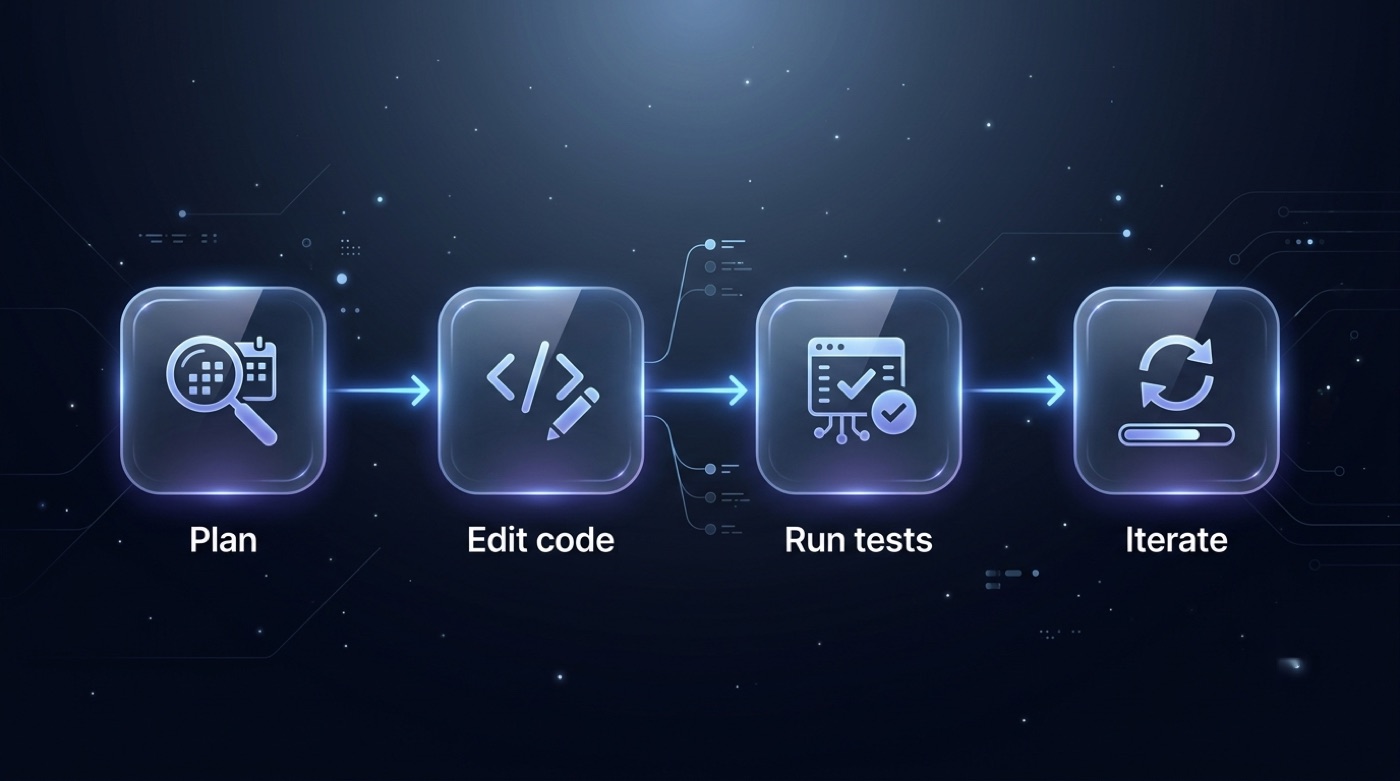
K3 is designed to plan first, then execute multi-step tasks with tools, checking its own output along the way rather than stopping after one action. The expanded coder-subagent toolset adds background tasks, todo lists, plan mode, skill invocation, and nested agents — the scaffolding needed for an agent that, say, reads a support ticket, edits the relevant code, runs the test suite, and iterates until the tests pass.
Tool use & function calling
K3 exposes tools through an OpenAI-compatible API, so existing function-calling and agent frameworks generally work with minimal changes — often just a base URL and model-id swap. That compatibility is documented on Moonshot’s API reference for developers wiring K3 into their own stack. Practical scenarios include web research agents that browse and synthesize, data-pipeline orchestration where the model triggers and monitors jobs, and retrieval-augmented generation (RAG) over internal document stores.
Use Case 4 — Research & Knowledge Work
Research is where the coding strength and the long context intersect: K3 can read a stack of papers, implement the described method, and validate the result in the same session.
Expert-level research assistant
Moonshot positions K3 as bridging scientific literature and executable code — reading papers, implementing what they describe, and analyzing the results. Among Moonshot’s reported demos: an astrophysics workflow that reportedly took roughly two weeks of human effort compressed into about two hours, including analysis of 391 gravitational-wave events, and reproduction of results across 20-plus papers spanning more than 3,000 lines of code. These are vendor demos from Moonshot’s own materials, not independently audited benchmarks, so treat the specific figures as directional.
Consulting-style knowledge work
The same capability set supports more everyday knowledge work: producing industry or market reports complete with interactive visualizations and dashboards, rather than static text.
Common outputs in this category:
- Competitive-analysis summaries pulled from multiple sources
- Literature reviews condensed from a stack of papers
- Briefing packs combining data tables, charts, and narrative summary
- Interactive dashboards built directly from a dataset
Use Case 5 — Writing & Content Creation
Writing benefits from the same long-context property that helps with documents, just applied to drafting instead of reading.
Long-form drafting with consistency
The 1M-token context keeps tone, terminology, and facts consistent across a long draft, a style guide, or a full documentation set — the model doesn’t lose track of earlier decisions as the piece grows. That’s useful for generating technical documentation from a codebase, turning source material into a structured report, or editing a long draft against a detailed brief without re-pasting context every few paragraphs.
Use Case 6 — Data Analysis & Visualization
K3 pairs code execution with reasoning, which makes it usable as a lightweight data-analysis tool rather than just a chat model.
From raw data to charts
A typical workflow: load a dataset, ask K3 to explore it, clean anomalies, compute summary statistics, and generate an interactive chart or dashboard from the result — all in one conversation rather than switching between a notebook and a chat window. Native vision adds a second path in: the model can also interpret an existing chart image and answer questions about it directly, which is useful when the “data” you have is a screenshot rather than a clean file.
Use Case 7 — Multilingual Tasks
As a model from a Chinese AI lab, Kimi K3 handles Chinese and English particularly strongly, alongside a broader range of other languages.
Cross-lingual work
Typical multilingual scenarios include translating documents, summarizing a document in one language into another, and localizing existing content. For example, a team could ask K3 to summarize a Chinese regulatory filing in English, or localize product documentation for a new market. Chinese-English performance is where Moonshot’s home-market focus shows most clearly; other languages are supported too, but quality varies by language.
How to Try Kimi K3
Moonshot AI has said, per its official blog, that Kimi K3 is available across the full Kimi product line at launch, plus third-party platforms like OpenRouter.
Access options and pricing
Here’s how to get to the model, and roughly what it costs, per Moonshot AI and OpenRouter at launch:
- Kimi.com — the official web chat interface
- Kimi Work — Moonshot’s productivity-oriented surface
- Kimi Code — the coding-focused product built around K3’s engineering strengths
- Kimi API — an OpenAI-compatible endpoint for developers, priced at $0.30 per million tokens for cache-hit input, $3.00 per million tokens for cache-miss input, and $15.00 per million tokens for output
- OpenRouter (
moonshotai/kimi-k3) — listed at $3 input / $15 output per million tokens, served by MoonshotAI as the sole provider
Open weights are expected to publish around July 27, 2026, roughly a week and a half after the model’s announcement. All of these prices and dates are as reported at launch and can change — check the official channels before budgeting around them.
If you’d rather skip the setup entirely, you can try Kimi K3 directly in the browser. One more time for clarity: kimik3.pro is an unofficial free chat and reference for Kimi K3, not an official Moonshot AI product.