
Kimi K3 vs Gemini: How Moonshot AI’s Open-Weight Model Compares to Google’s Gemini
Moonshot AI’s newest release, Kimi K3, is the latest entry in its open-weight Kimi lineup. Gemini, by contrast, is Google DeepMind’s proprietary, natively multimodal family, built into Google’s products and cloud APIs. This guide lines the two up on the dimensions that actually matter for choosing between them — openness, coding, context length, agentic behavior, multimodality, and access.
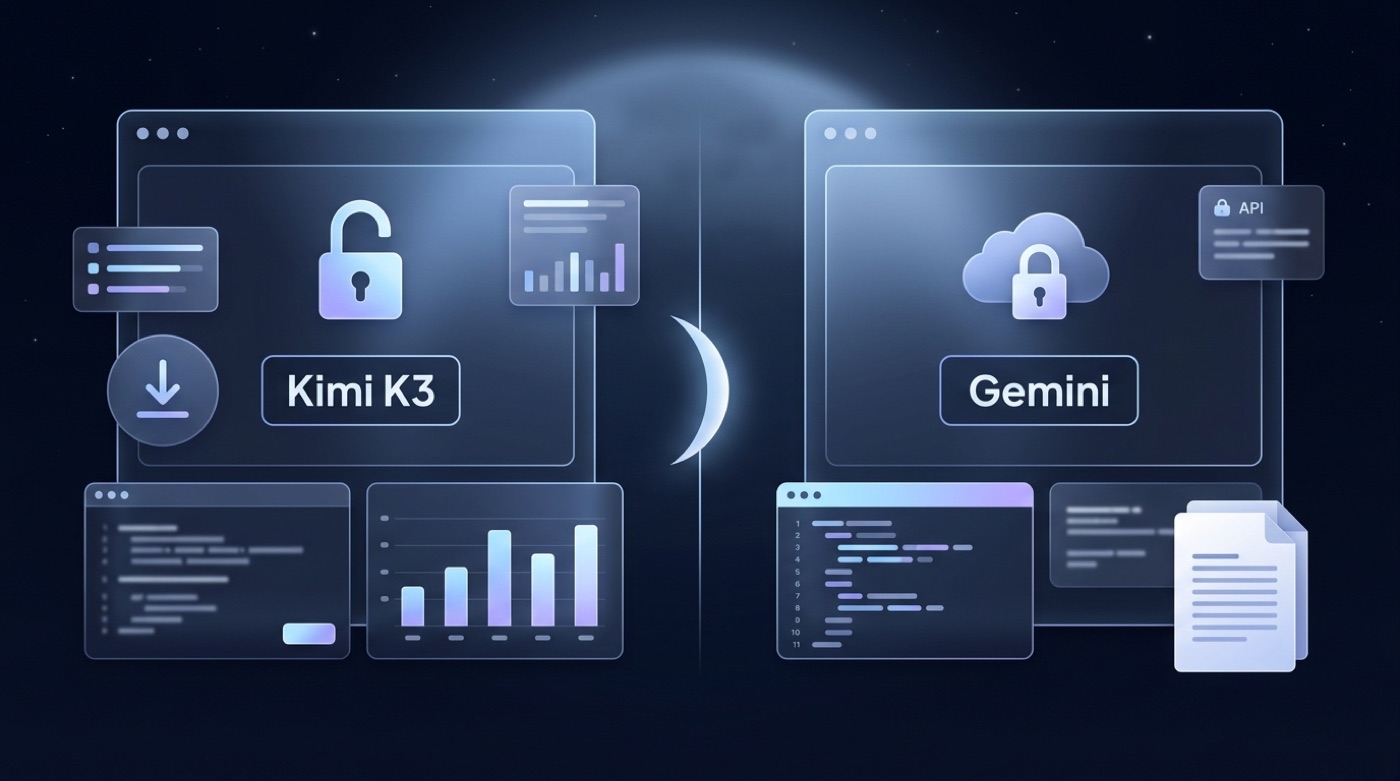
Because Kimi K3 is very new, treat any circulating head-to-head benchmark numbers with caution — plenty of unverified figures are already floating around online. This comparison stays qualitative and points back to official sources wherever possible.
Kimi K3 and Gemini at a glance
The two models come from different traditions: one open and community-extensible, the other closed and deeply integrated into a single company’s ecosystem. The table below lays out the qualitative differences before the deeper sections unpack each one.
| Dimension | Kimi K3 (Moonshot AI) | Gemini (Google DeepMind) |
|---|---|---|
| Maker | Moonshot AI (Beijing) | Google DeepMind |
| Lineage | Newest in the Kimi family; follows open-weight Kimi K2 | Gemini family; follows earlier Gemini generations |
| Openness | Open-weight heritage (weights can be downloaded/self-hosted) | Proprietary (API / subscription only) |
| Multimodality | Strong text + vision focus | Natively multimodal (text, image, audio, video, code) |
| Long context | Long context window (Kimi known for long context) | Long context window (million-token class) |
| Best-known strength | Coding & agentic workflows, openness, value | Multimodality, integrated Google ecosystem |
Read across the rows and the pattern holds throughout the rest of this comparison: Kimi K3 trades a closed ecosystem for control and flexibility, while Gemini trades that flexibility for a fully managed, richly multimodal service.
Who builds them: Moonshot AI vs Google DeepMind
Kimi K3 — the newest Kimi from Moonshot AI
Moonshot AI is a Beijing-based lab, and Kimi K3 is the latest entry in its Kimi line, succeeding the open-weight Kimi K2 — a mixture-of-experts model that made waves for being downloadable rather than locked behind an API. According to Wikipedia’s entry on Moonshot AI, the company has built its reputation on releasing capable models with open weights, and Kimi K3 continues that pattern as the newest model in the family. Exact architectural specifics for K3 are still settling as coverage catches up, so treat granular technical claims about it as provisional rather than fixed.
Gemini — Google DeepMind’s proprietary family
Gemini is Google DeepMind’s family of multimodal large language models, delivered through Google’s own apps, the Gemini API and AI Studio, and Google Cloud. On DeepMind’s Gemini models page, the family is promoted around “long horizon” workflows, and a featured customer testimonial praises a Gemini model for how it “reliably calls tools” — positioning Gemini less as a single chatbot and more as an engine behind a broad set of Google products and third-party integrations. Wikipedia’s Gemini (language model) entry notes that Gemini remains Google-controlled, distinct from Google’s separately released open Gemma models, which share some research lineage but ship under different, open terms.
Openness: open-weight heritage vs proprietary
This is the single biggest philosophical split between the two families, and it shapes almost every other difference on this page. Kimi’s lineage is open-weight: Wikipedia notes that “Kimi K2 is an open source LLM, meaning that it can be downloaded and built upon by users,” and Kimi K3 carries that heritage forward as the newest model in the line. Gemini takes the opposite approach — it is accessed exclusively through Google’s apps, subscriptions, and metered cloud APIs, with no equivalent option to download and run the weights yourself.
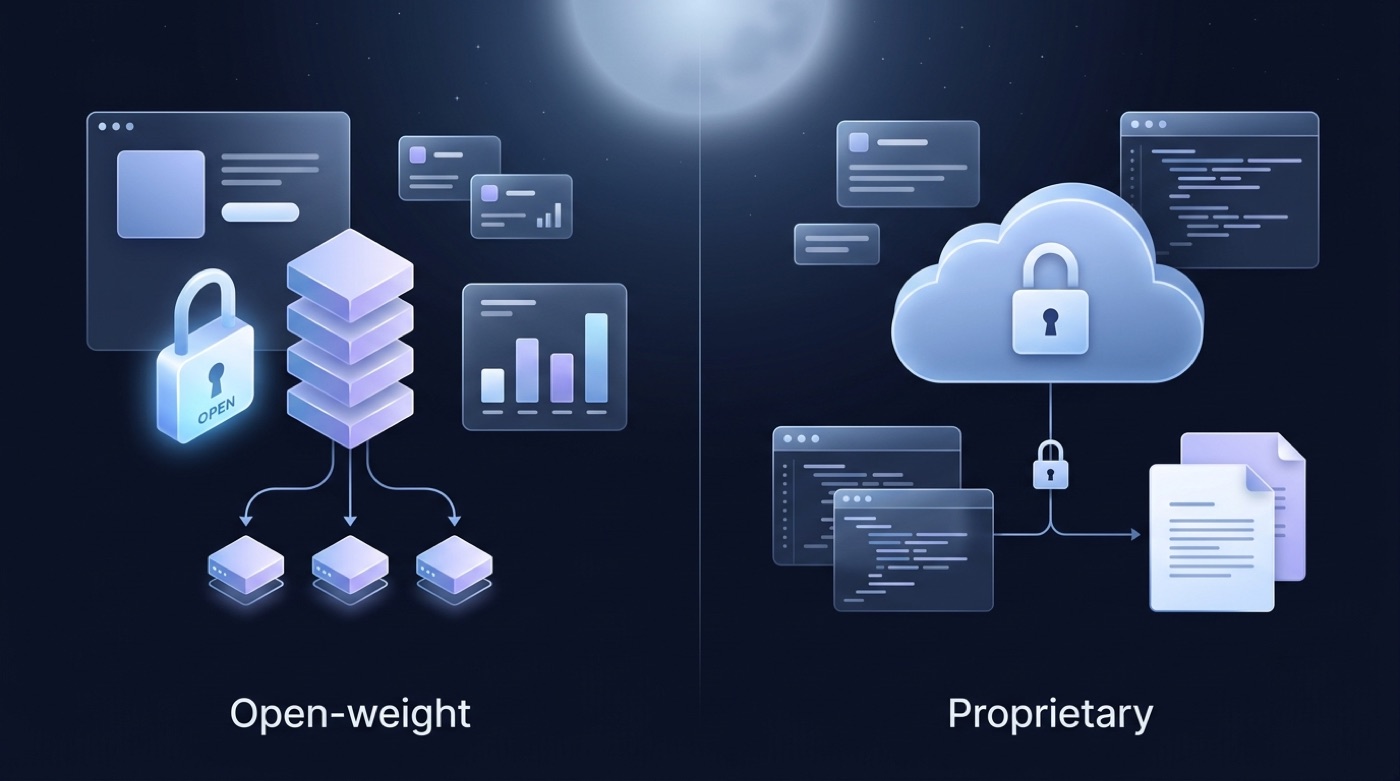
What that split means in practice:
- Self-hosting. Open-weight models in the Kimi line can, in principle, be downloaded and run on your own infrastructure — Gemini cannot.
- Inspection and fine-tuning. Open weights let researchers and developers inspect, modify, and fine-tune the model directly; Gemini’s internals stay closed.
- No vendor lock-in. An open-weight model can be hosted by multiple independent providers, so you aren’t tied to a single vendor’s pricing or roadmap.
- Managed convenience. Gemini’s proprietary model trades that flexibility for a fully managed service — no infrastructure to run, but also no way to self-host or modify it.
- Ecosystem integration. Gemini’s closed model plugs directly into Google Search, Workspace, and Android in ways an independently hosted model cannot easily replicate.
Coding
Both families are pitched heavily at developers, but they lean into that pitch from different angles. DeepMind promotes Gemini’s coding orientation as “agentic coding” — models built to tackle complex development tasks and, per a customer testimonial on DeepMind’s own page, to “reliably call tools” as part of completing a task rather than just producing a code snippet in isolation. Kimi’s line has built its reputation partly on coding and agentic value as part of an open-weight package, though specific coding benchmark comparisons between K3 and Gemini are not something this guide asserts — those figures circulating online should be checked against each vendor’s own published results before you rely on them.
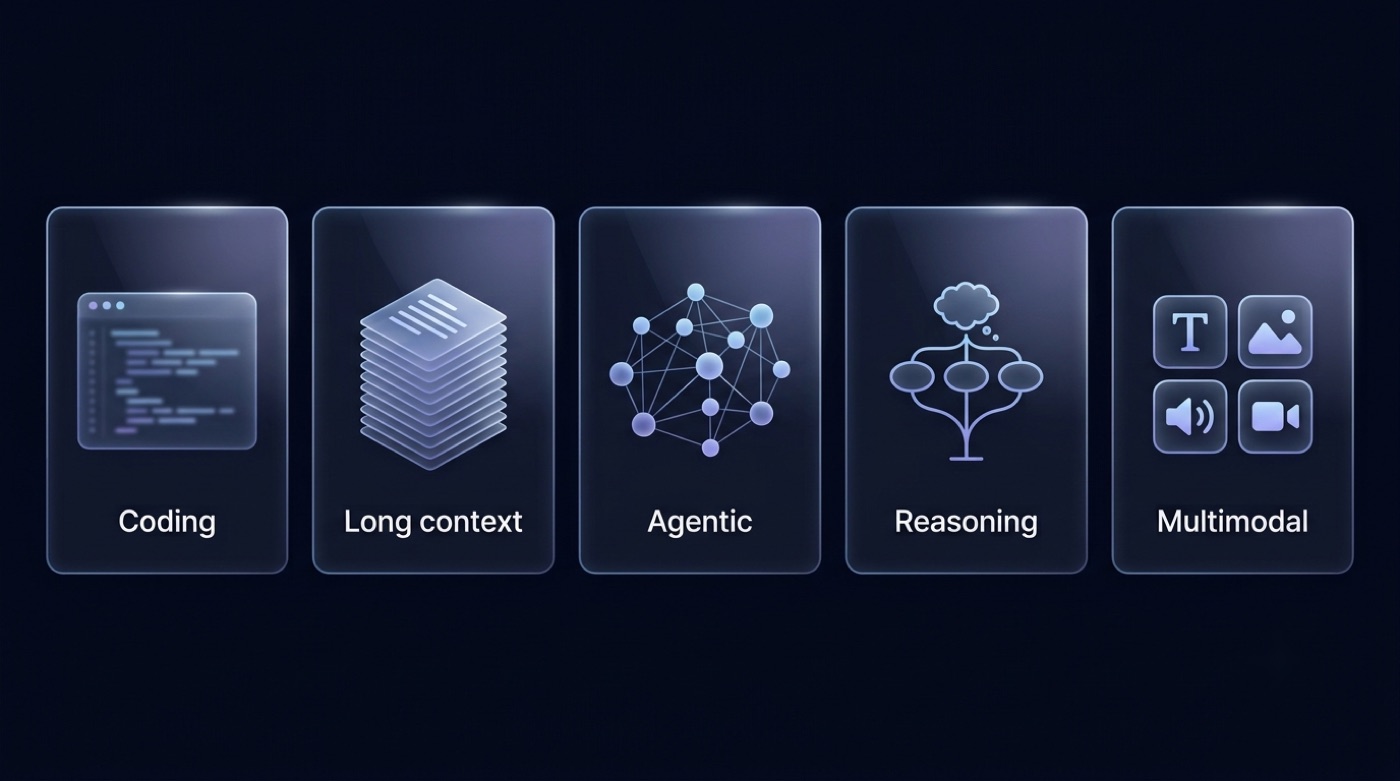
When you’re actually deciding which model to route coding work through, a few practical considerations matter more than any single score:
- Repo-scale editing. Can the model keep enough context to make coherent changes across multiple files, not just one function at a time?
- Tool-calling loops. Does it reliably invoke linters, test runners, or search tools mid-task, and recover when a call fails?
- IDE and ecosystem fit. Gemini’s tie-in to Google’s developer tooling may matter more if your stack already lives there; an open-weight Kimi model may fit better if you’re building your own tool-calling harness.
- Cost sensitivity. Self-hostable, open-weight models give you a lever to control cost that a metered proprietary API does not.
Kimi K2 is an open source LLM, meaning that it can be downloaded and built upon by users.
Moonshot AI — Wikipedia
That open-source framing is worth keeping in mind throughout this comparison — it’s the throughline that separates Kimi’s whole approach from Gemini’s.
Long context
Long context windows matter for anything that doesn’t fit neatly into a short prompt — large codebases, long documents, extended conversation history, or big batches of retrieved text. Both families compete on this axis, but they got there from different starting points.
Why it matters. A short context window forces you to chunk documents or summarize conversation history before the model can use it; a long one lets the model reason over an entire codebase, contract, or research paper in one pass, which tends to produce more coherent answers on large-scope tasks.
Where Gemini stands. Gemini’s context window reached what Wikipedia describes as a million-token-class window with the 1.5 Pro generation, letting it hold enormous amounts of text or code in a single pass — one of the largest windows publicly documented among major model families.

Where Kimi K3 stands. Kimi’s lineage has likewise been associated with long-context handling as a core selling point going back to earlier Kimi releases. For K3 specifically, it’s best to say it is reported to offer a large context window rather than cite an exact token count as settled fact — precise figures for the newest release are still being confirmed across independent sources, and this guide avoids asserting a number that hasn’t been verified.
Agentic and tool use
“Agentic” behavior — a model that plans multiple steps, calls external tools, and works through a task over an extended horizon rather than answering in one shot — is where both companies are currently pointing their marketing and their research. DeepMind’s Gemini models page frames the family around long-horizon tasks, and a customer testimonial featured there says a Gemini model “follows complex instructions with minimal prompt tuning and reliably calls tools.” Kimi’s line is positioned similarly around agentic and tool-heavy workloads, though — as with coding — specific agentic benchmark claims for K3 should be treated as unverified until confirmed by primary sources.
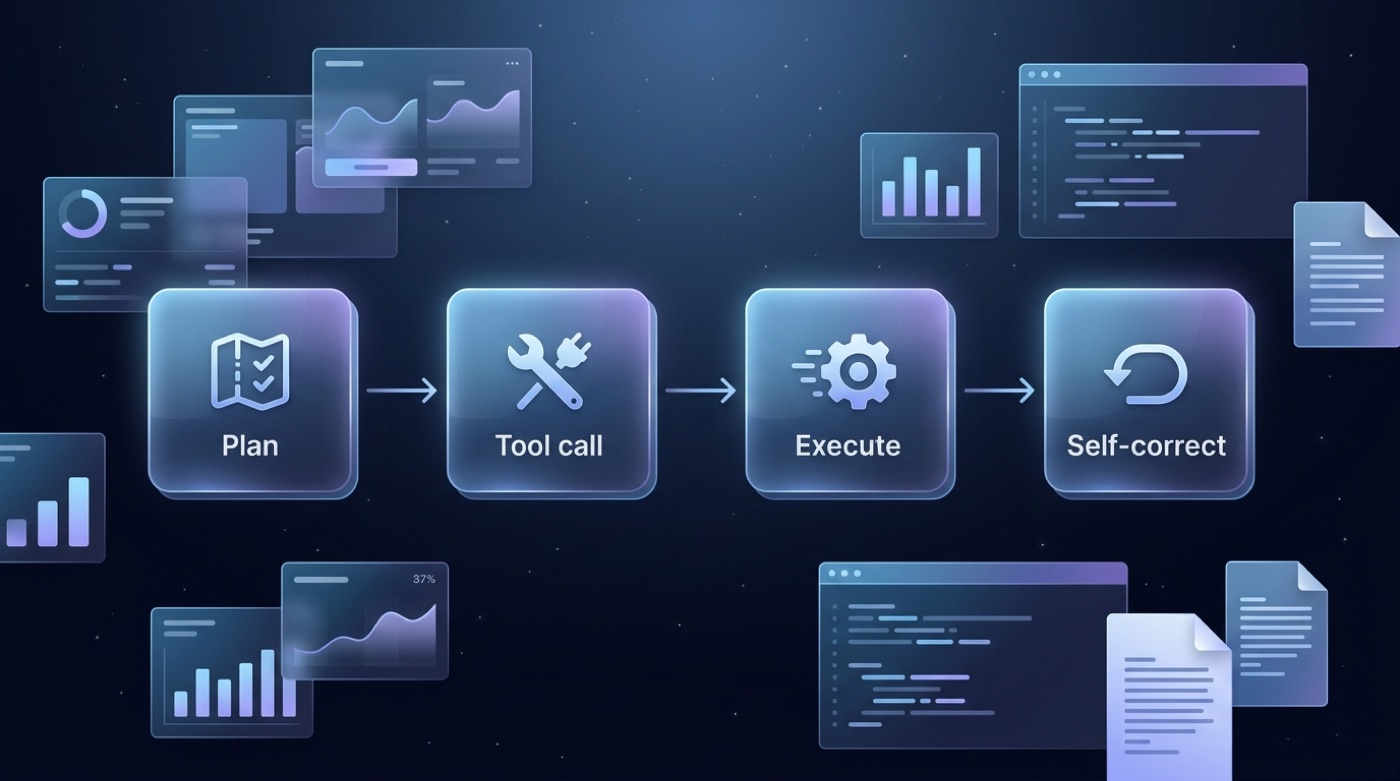
In practice, “agentic” tends to break down into the same handful of capabilities regardless of which model is doing the work:
- Multi-step planning — breaking a broad goal into an ordered sequence of smaller actions.
- Tool calls — invoking search, code execution, file access, or other external functions mid-task.
- Long-horizon execution — sustaining a task across many steps without losing track of the original goal.
- Self-correction — noticing a failed step or a bad tool result and adjusting course instead of pushing forward blindly.
Reasoning and multimodality
Multimodality
This is Gemini’s clearest structural edge. Wikipedia describes Gemini as natively multimodal, built to work across text, image, audio, video, and code within a single model rather than bolting separate modalities onto a text-first base. Kimi’s line, by comparison, centers on text and vision — strong at reading and reasoning over images alongside text, but without the same breadth across audio and video that Gemini advertises. If your use case depends on native audio or video understanding, that’s the qualitative divide to weigh most heavily.
Reasoning
Both families emphasize reasoning as a core capability rather than an afterthought, and both have shipped variants aimed specifically at multi-step, chain-of-thought-style problem solving. Some coverage of the Kimi line mentions a reasoning effort control — the ability to dial how much computation a query gets — but that should be treated as a reported feature rather than a confirmed, fixed spec until Moonshot AI documents it directly. Keep reasoning comparisons qualitative: both models are built for it, and neither has a settled, independently verified edge worth stating as fact here.
Cost and access
Rather than quoting prices — figures for a model this new change quickly and much of what’s circulating is unverified — it’s more useful to frame this as a question of access. Kimi’s open-weight heritage means it can be self-hosted (at the cost of your own infrastructure) or accessed through third-party hosted API providers, including a range of unofficial free chat interfaces. Gemini is accessed through Google’s own apps, the Gemini API / AI Studio, and Google Cloud, all under Google’s subscription and metered-API terms.
| Aspect | Kimi K3 | Gemini |
|---|---|---|
| How to access | Open weights (self-host) + hosted API providers; unofficial free chats | Google apps, AI Studio / Gemini API, cloud (proprietary) |
| Self-hosting | Possible (open-weight heritage) | Not available (proprietary) |
| Ecosystem | Independent / open ecosystem | Deep Google integration |
| Cost model | Value-oriented; varies by host | Subscription / metered API |
Kimi’s open lineage tends to get described as cost-competitive relative to closed alternatives, but treat that as a general reputation rather than a specific dollar comparison — actual cost depends heavily on which host or plan you pick, and any $/token figures you see quoted should be verified against the provider’s current pricing page before you budget around them.
Which should you choose?
There’s no universal winner here — the right pick depends on what you’re optimizing for. A quick way to work through the decision:
- List your must-have modalities. If audio or video understanding is non-negotiable, that already tilts toward Gemini.
- Check your infrastructure appetite. If you’re willing and able to self-host, Kimi K3’s open weights become a real option; if not, a managed API is simpler either way.
- Weigh your ecosystem lock-in. Heavy Google Workspace or Cloud users get more out of Gemini’s native integration than an independent stack would offer.
- Estimate your usage volume. High-volume, cost-sensitive workloads are where an open-weight model’s ability to shop across hosts tends to pay off.
- Pilot both on a real task. Run the same coding or agentic task through each and compare the actual output quality for your use case, rather than relying on secondhand benchmark claims.
- Pick Kimi K3 if you want open weights and the option to self-host, your priority is coding-and-agent workflows, you want to build on an independent stack rather than a single vendor’s platform, or cost-sensitivity matters and you’re willing to shop across hosts.
- Pick Gemini if you need native audio and video multimodality alongside text and image, you’re already embedded in the Google ecosystem (Workspace, Cloud, Android), or you’d rather have a fully managed proprietary service than manage infrastructure yourself.
Both are frontier-class models as of this writing, and the right choice comes down to how much you value openness and self-hosting versus native multimodality and a managed, integrated service. If you want to see Kimi K3’s open-weight approach firsthand, try Kimi K3 before committing either way.
FAQ
kimik3.pro is an unofficial free chat and reference. It is not affiliated with, endorsed by, or sponsored by Moonshot AI or Google/Google DeepMind.